JEE Mains 2025 Physics Superposition of Waves Question | 8th April Shift 2 PYQ Solved
In this post, we solve a JEE Mains 2025 Physics question from the 8th April Shift 2 paper. The question is based on the superposition of two harmonic travelling waves — a key concept from Wave Motion. Read the step-by-step solution and watch the video explanation to fully understand the method.
Question
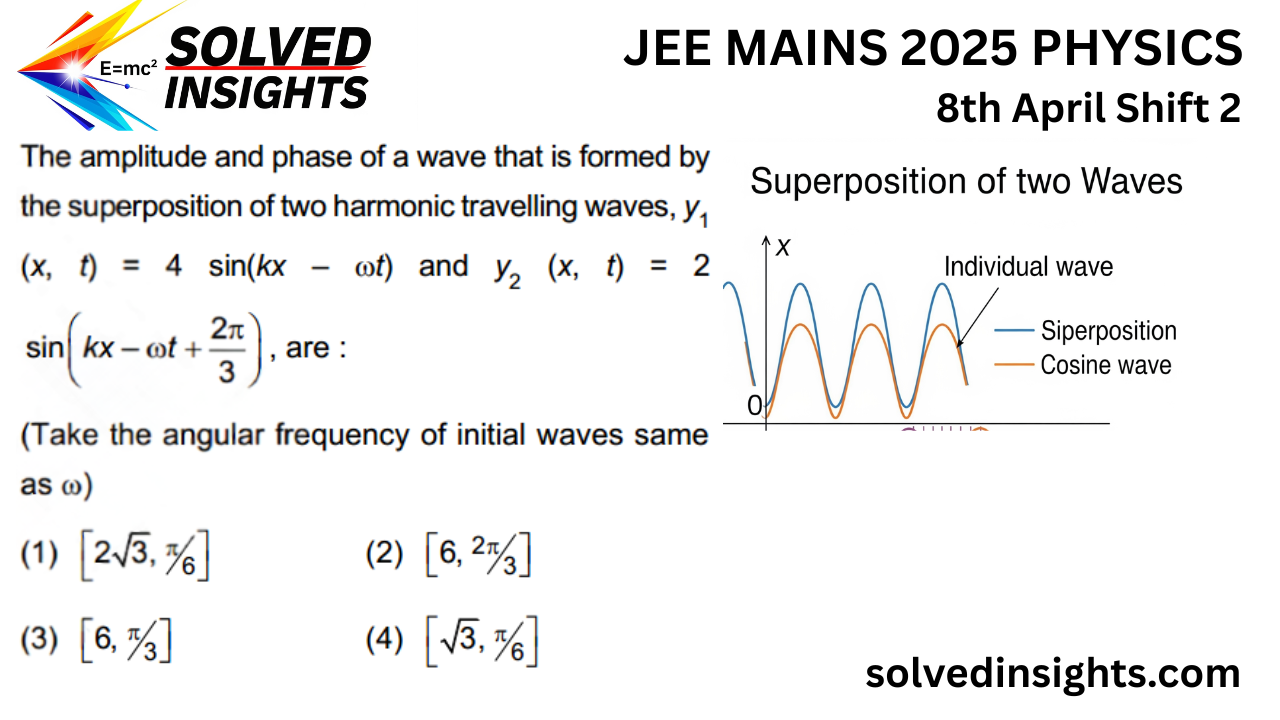
The amplitude and phase of a wave formed by the superposition of two harmonic travelling waves:
y₁(x, t) = 4 sin(kx − ωt)y₂(x, t) = 2 sin(kx − ωt + 2π/3)
The resultant wave is of the form:y(x, t) = A sin(kx − ωt + φ)
Find the values of Amplitude (A) and Phase (φ).
(Take angular frequency of both waves as ω)
Options:
- (1) [2√3, π/6]
- (2) [6, 2π/3]
- (3) [6, π/3]
- (4) [√3, π/6]
More JEE Mains 2025 Physics PYQs
Detailed Step-by-Step Solution
Step 1: Use Phasor Method for Addition
We represent both sine waves as phasors. First, rewrite the second wave to align phases:
y₁ = 4 sin(kx − ωt) = 4 sinθy₂ = 2 sin(kx − ωt + 2π/3) = 2 sin(θ + 2π/3)
Step 2: Expand the Second Wave Using Identity
Using the identity: sin(A + B) = sinA cosB + cosA sinBy₂ = 2[sinθ cos(2π/3) + cosθ sin(2π/3)]y₂ = 2[-1/2 sinθ + √3/2 cosθ]y₂ = -sinθ + √3 cosθ
Step 3: Add y₁ and y₂
y = y₁ + y₂ = 4 sinθ + (-sinθ + √3 cosθ)y = 3 sinθ + √3 cosθ
Step 4: Convert to Single Sine Form
y = A sin(θ + φ) where:A = √(a² + b²) = √(3² + (√3)²) = √(9 + 3) = √12 = 2√3φ = tan⁻¹(b/a) = tan⁻¹(√3 / 3) = π/6
✅ Final Answer:
Amplitude A = 2√3, Phase φ = π/6
Correct Option: (1)
Watch the Full Video Solution
Watch this detailed video explanation on our YouTube channel:
Conclusion
This question tests your understanding of wave superposition and phasor addition — a common theme in JEE Physics. Mastering these fundamentals will help you solve many advanced wave problems with confidence.
Follow Us
Stay connected for more solved questions, tips, and exam strategies: