JEE Mains 2025 Physics: Electric Charge Distribution on Irregular Metallic Disk (Solved PYQ)
Preparing for JEE Mains 2025 Physics? This post breaks down a common but tricky problem from the topic of Electrostatics – Surface Charge Density and Curvature. Understand how charge distributes on an irregular metallic conductor and avoid common mistakes in exams.
🎥 Watch the Full Video Solution
This video explains the complete step-by-step solution. Watch it first before reading the detailed breakdown below:
Question
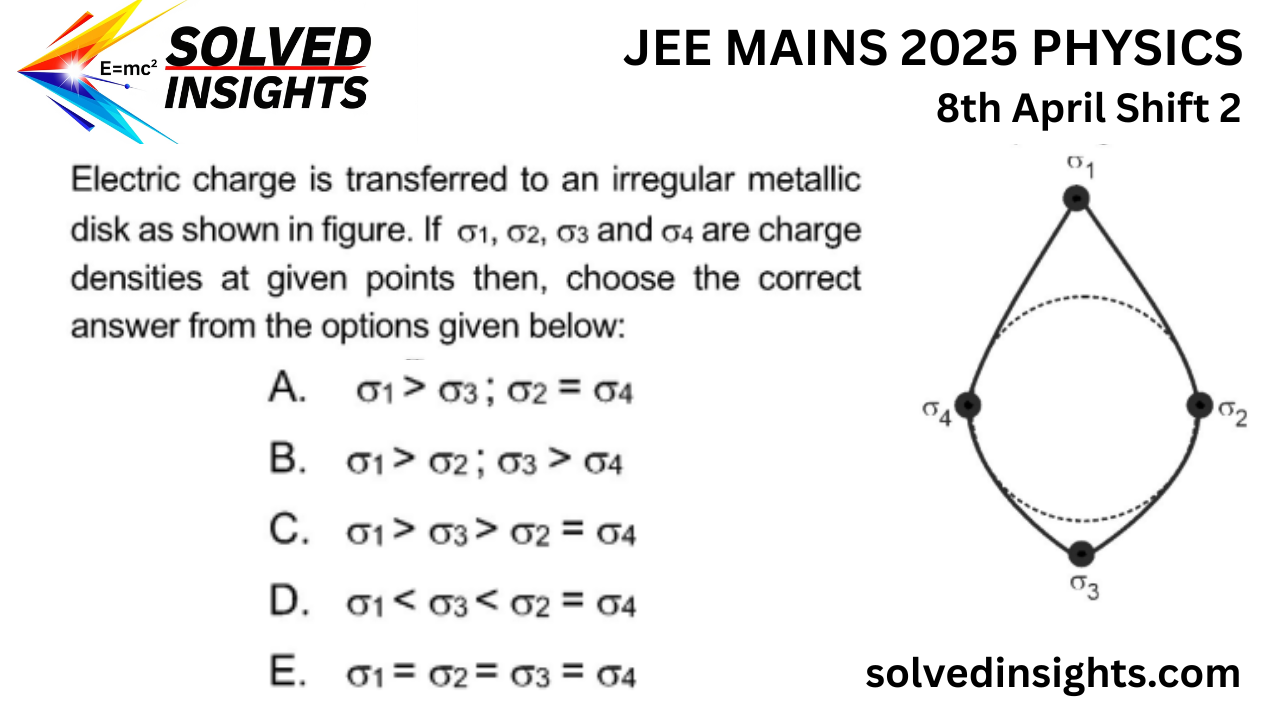
Electric charge is transferred to an irregular metallic disk as shown in the figure. If σ₁, σ₂, σ₃, and σ₄ are the surface charge densities at the given points, choose the correct answer from the options below:
- A. σ₁ > σ₃ ; σ₂ = σ₄
- B. σ₁ > σ₂ ; σ₃ > σ₄
- C. σ₁ > σ₃ ≥ σ₂ = σ₄
- D. σ₁ < σ₃ < σ₂ = σ₄
- E. σ₁ = σ₂ = σ₃ = σ₄
Options:
- A and C Only
- D and E Only
- A, B and C Only
- B and C Only
Detailed Step-by-Step Solution
Step 1: Understand the Concept of Charge Distribution
On a metallic conductor in electrostatic equilibrium, the surface charge density is not uniform if the object has an irregular shape. The charge density is directly related to the local curvature of the surface:
σ ∝ Curvature
Sharper points (higher curvature) accumulate more charge, while flatter regions have less surface charge density.
Step 2: Analyze the Given Figure
- σ₁ is located at the sharpest point at the top → Maximum curvature
- σ₃ is at the bottom tip → Less sharp than σ₁
- σ₂ and σ₄ are on the sides → Flat regions with equal curvature
Step 3: Compare the Surface Charge Densities
Based on curvature, the correct order is:
σ₁ > σ₃ > σ₂ = σ₄
Step 4: Match the Options
- A: σ₁ > σ₃ ; σ₂ = σ₄ → ✅ Correct
- B: σ₁ > σ₂ ; σ₃ > σ₄ → ✅ Correct (since σ₃ > σ₄)
- C: σ₁ > σ₃ ≥ σ₂ = σ₄ → ✅ Correct
- D: σ₁ < σ₃ < σ₂ = σ₄ → ❌ Incorrect
- E: σ₁ = σ₂ = σ₃ = σ₄ → ❌ Incorrect
Step 5: Final Answer
The correct answer is:
Option (3): A, B and C Only
Conclusion
This problem illustrates how surface charge density varies with curvature on a conductor. Remember: sharper points accumulate more charge. This concept is frequently tested in JEE Mains and Advanced.